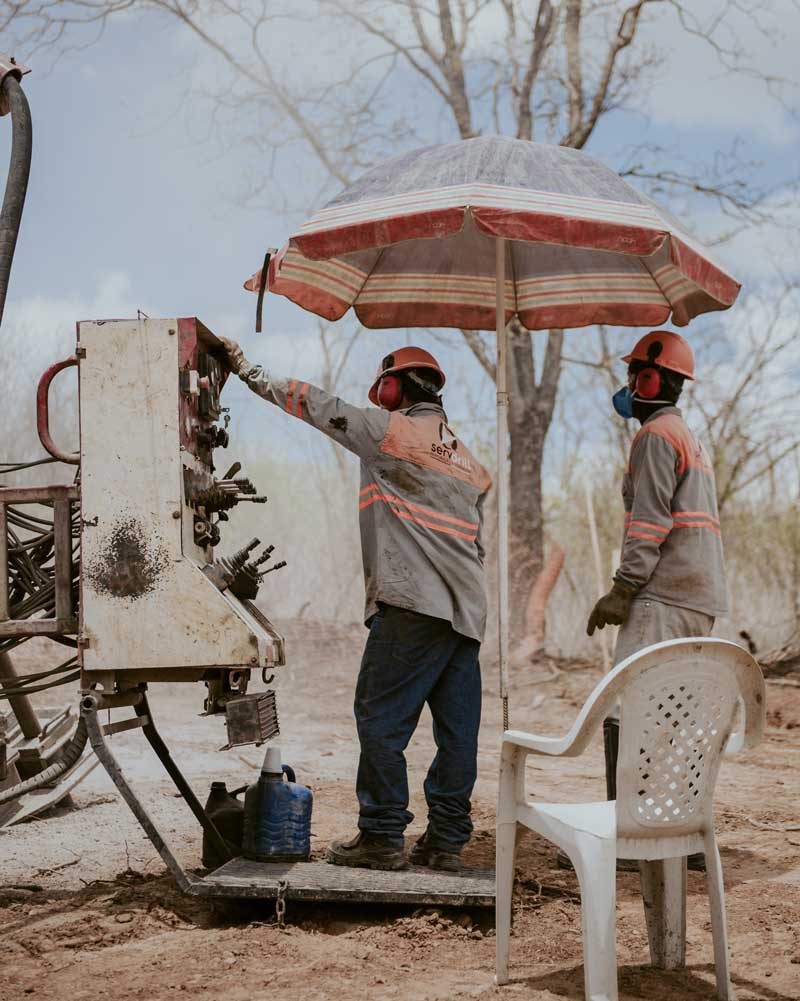
Pedra Branca Gold Project


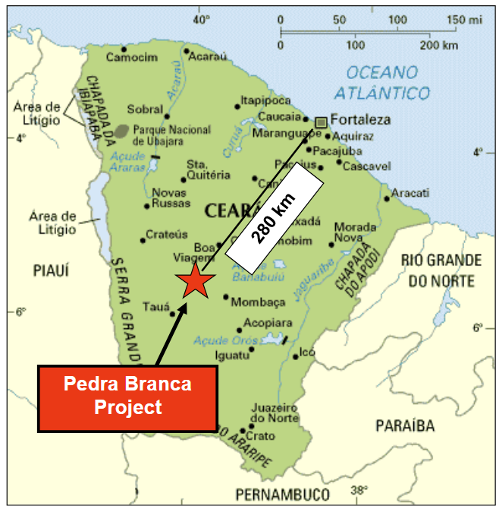
Exploration at Pedra Branca spans multiple campaigns from 1980s discovery through to the current Phase III program. The consolidated database includes 253 drill holes (90 diamond and 163 RC) totaling 15,517m of drilling, plus 650 surface trenches (56,892m of trenching), across 9 NI 43-101 targets (part of 13 identified anomalies). Drilling and trenching are distinct sampling categories and are not combined.
The Maiden Inferred Resource of 180,000 oz Au (4.0 Mt @ 1.38 g/t, 0.40 g/t cut-off) was defined from only 3 of the 13 targets, drilled to an average depth of just 99m. Metallurgical testing confirms 92–98% gold recovery via conventional CIL processing, with 63.8% gravity-recoverable gold.
| Target | Hole | From (m) | Width | Au g/t |
|---|---|---|---|---|
| Queimadas | FCC002 | 45.35 | 13.75m | 6.86 |
| Queimadas | FCC016 | 90.20 | 1.0m | 43.70 |
| Mirador | FMC008 | 3.10 | 4.05m | 11.63 |
| Mirador | FMC005 | 9.20 | 3.85m | 11.90 |
Source: NI 43-101 Technical Report – Mineral Resource Estimation for the Pedra Branca Gold Project, Ceará State – Brazil (effective March 16, 2021; Rodrigo Mello, FAusIMM), Appendix B. Intervals are downhole lengths; true widths have not been determined. Broader, lower-grade composites of certain intervals were reported in the April 14, 2026 news release.
| Target | Trench | Width | Au g/t | Disclosed |
|---|---|---|---|---|
| Igrejinha | TIG044 (historical) | 6.4m | 19.18 | NR Apr 14, 2026 |
| Mir Coelho | Trench (ID not disclosed) | 13.0m | 4.45 incl. 1m @ 55.84 | NR Jan 20, 2021 |
| Barra Nova | PBTR047 | 3.0m | 32.63 incl. 1m @ 96.04 | NR May 6, 2022 |
Trench results are surface channel samples; widths are sampled lengths, not true widths. These are exploration results and are not necessarily included in the 2021 mineral resource estimate (the Barra Nova target lies outside it). The Igrejinha trench result (TIG044) is a historical result (Jaguar, 2010) that predates the Company: QA/QC records are not available and it has not been verified by the Company’s qualified person.
| Target | Category | Tonnes (Kt) | Grade (g/t Au) | Au (koz) |
|---|---|---|---|---|
| Queimadas | Inferred | 3,189 | 1.24 | 128 |
| Mirador | Inferred | 638 | 1.97 | 40 |
| Igrejinha | Inferred | 215 | 1.73 | 12 |
| TOTAL | Inferred | 4,042 | 1.38 | 180 |
Cut-off grade: 0.40 g/t Au. QP: Rodrigo Mello, FAusIMM (RBM Consultoria). Effective date: March 16, 2021. Inferred resources have insufficient confidence for economic evaluation. View all SAO filings on SEDAR+.
| Metric | Result | Source |
|---|---|---|
| CIL Gold Recovery | 97.7% (Coelho); 92.6% (Queimadas 2022) | NI 43-101 (2021); SAG Metallurgical Testing (Nov 2022) |
| Gravity Gold Recovery | 63.8% (Falcon Concentrator, Queimadas) | SAG Metallurgical Testing (Nov 2022) |
| Ore Type | Fresh, sulfide-bearing (pyrrhotite-dominant, free-milling) | NI 43-101 (2021); Phase III Exploration Data Study |
| Arsenic Risk | Negligible (arsenopyrite trace, non-refractory) | NI 43-101 (2021); Sulfide Mineralogy Assessment |
Source: NI 43-101 Technical Report (March 16, 2021, QP: Rodrigo Mello, FAusIMM) and SAG Metallurgical Testing Program (2022)
On April 14, 2026, the Company announced commencement of mobilization for its fully funded Phase III diamond drill program at Pedra Branca. The 5,000-metre program, announced April 14, 2026, comprises diamond drilling across three priority targets over approximately 8 months.
Program scope (as announced April 14, 2026):
Funding: The program is valued at approximately C$3.0 million and is fully funded from the C$4.2 million private placement closed March 13, 2026. A concurrent $500,000 debt settlement via 10 million shares at the placement price was also completed at close.
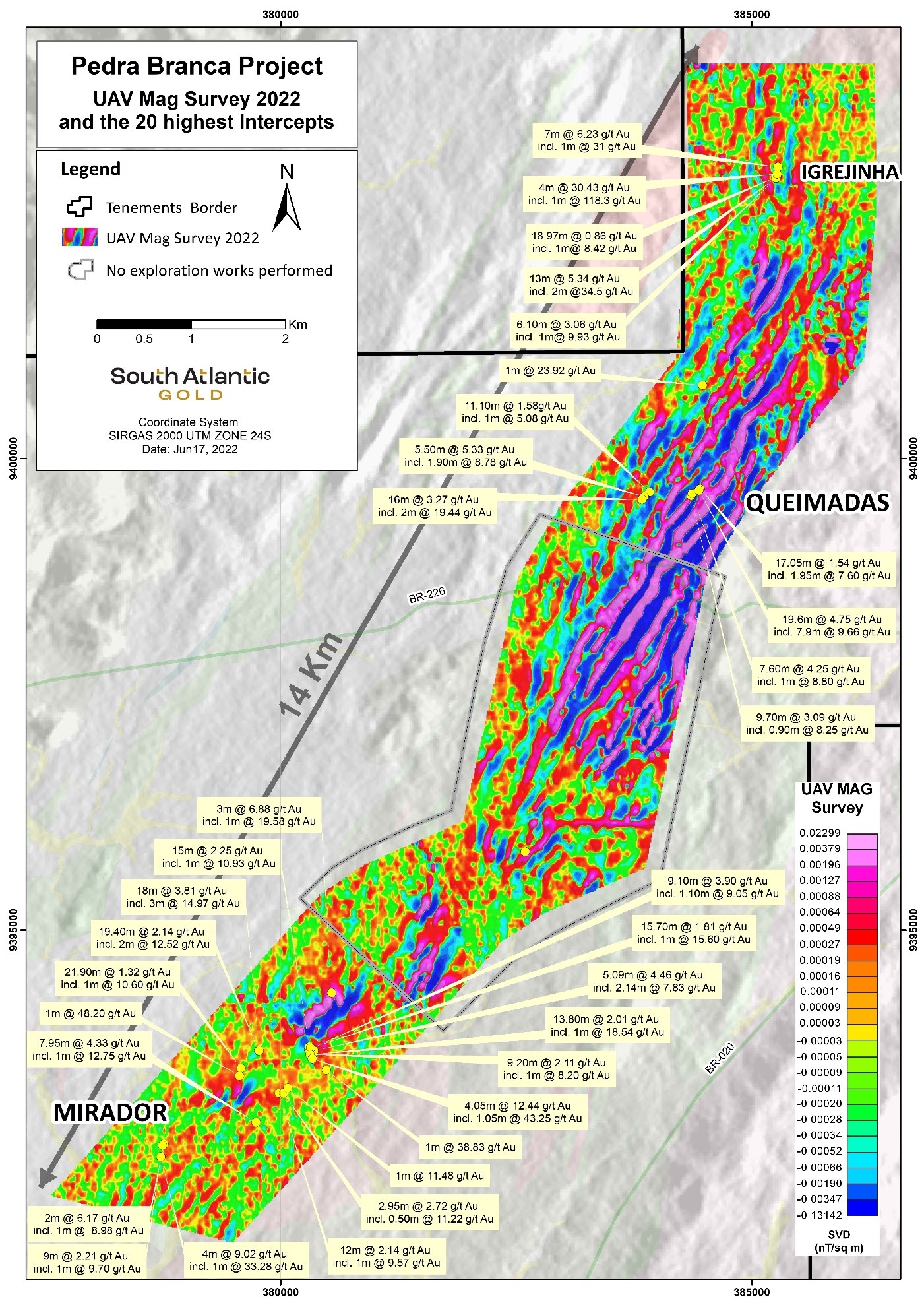
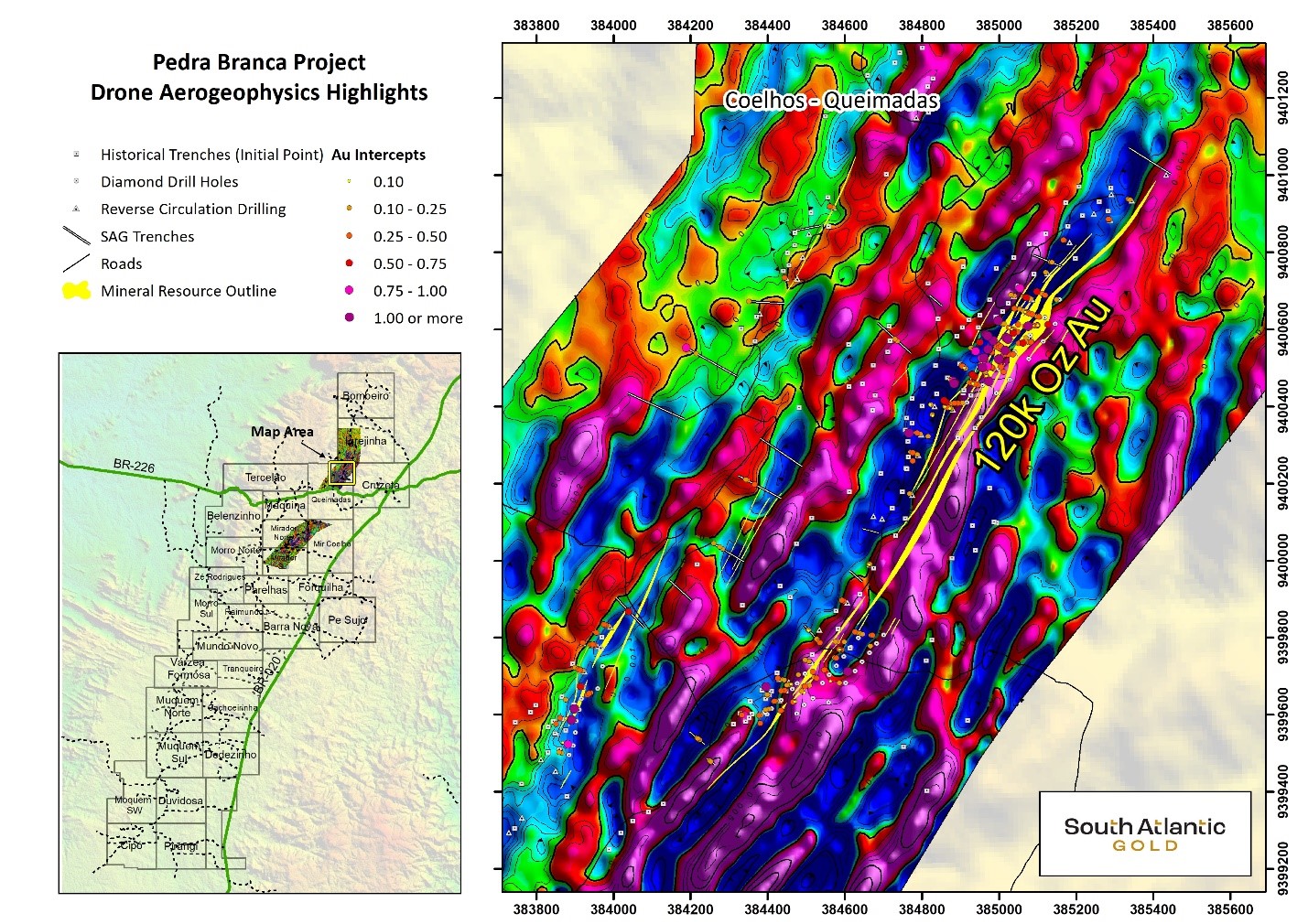
Queimadas is the main host of the 180,000 ounces gold Inferred Mineral Resource (NI 43-101, March 2021, 4.0 Mt @ 1.38 g/t Au, 0.40 g/t cutoff), with previous drilling returning persistent gold mineralization to 201m (FCC019). Mirador and Igrejinha, together holding resource material, have not yet been extensively tested at depth.
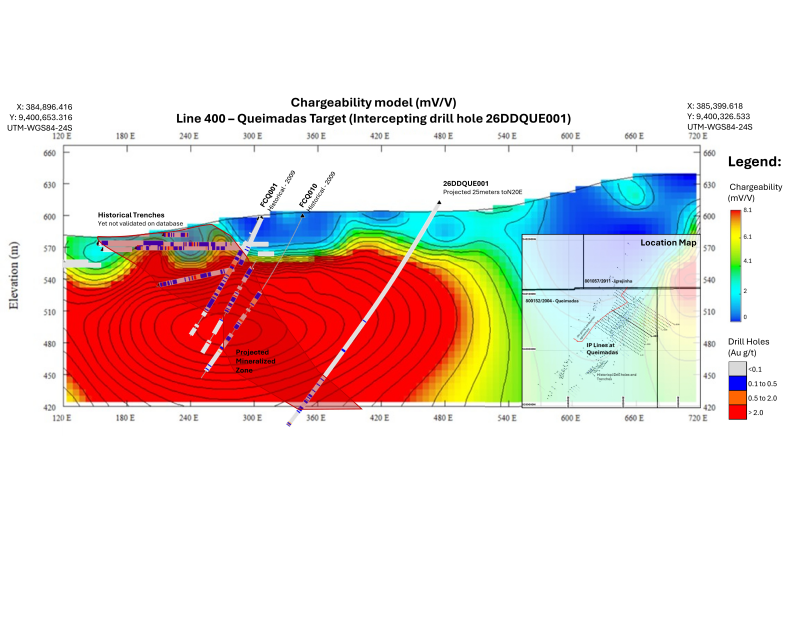
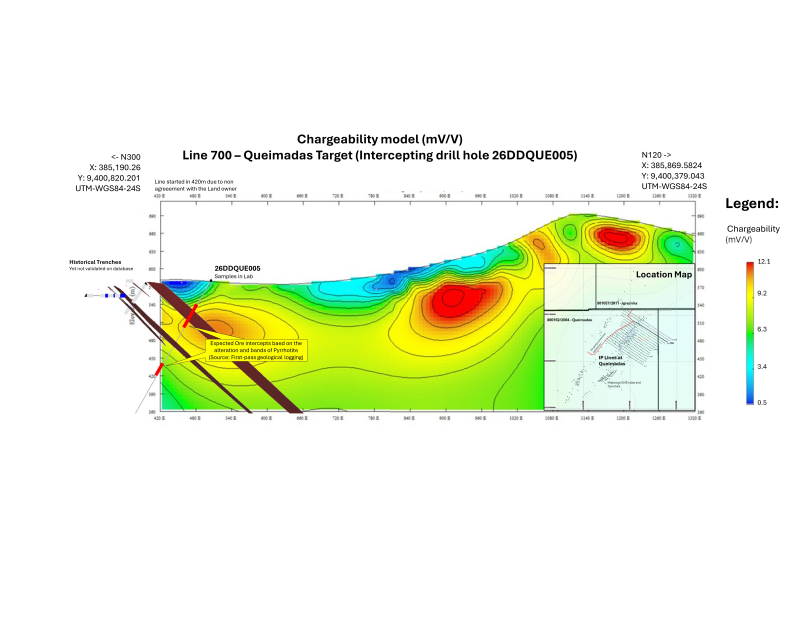
These observations are based on preliminary field data; data processing and 2D/3D inversion will follow on completion of acquisition and, once reviewed by the Qualified Person, will inform target refinement and subsequent drilling design. Chargeability reflects the sub-surface distribution of sulphide minerals, which are not necessarily gold-bearing; geophysical anomalies represent exploration targets only and require drill testing and laboratory assay to evaluate.
The Pedra Branca Gold Project hosts a NI 43-101 compliant Inferred Mineral Resource of 4.0 million tonnes grading 1.38 g/t gold, containing approximately 180,000 ounces of gold, estimated at a 0.40 g/t gold cut-off grade (technical report effective March 16, 2021; QP: Rodrigo Mello, FAusIMM). An Inferred Mineral Resource has a lower level of confidence than an Indicated Mineral Resource, must not be converted to a Mineral Reserve, does not have demonstrated economic viability, and there is no certainty that all or any part of the Inferred Mineral Resource will be upgraded to a higher category.
The Phase III exploration program is conducted under the supervision of Marcelo Antonio Batelochi, P.Geo., MAusIMM (CP), Senior Vice-President, Exploration, who is a Qualified Person as defined by NI 43-101. Matt Rees, P.Geo., a former senior geologist with IAMGOLD, serves as Technical Advisor to the project.
Videos may contain forward-looking information; actual results may differ materially. The Company's mineral resource is 180,000 oz Au Inferred (NI 43-101 technical report effective March 16, 2021; QP Rodrigo Mello, FAusIMM; 0.40 g/t Au cut-off); Inferred resources cannot support economic analysis. Scientific and technical content reviewed by Marcelo Antonio Batelochi, P.Geo., MAusIMM (CP), the Company's Qualified Person. See full cautionary statements.
Exploration at Pedra Branca happens alongside the communities of Ceará. Jauner Torquato, community relations for the project, on how the Company works with its host communities as exploration advances.